A community midwife's honest write-up
I've been a midwife for 9 years. I can usually tell, in one visit, which babies will still be exhausted at five months.
It isn't temperament. It isn't feeding method. It's one thing almost every family gets told to ignore — and the one rule we still print on our box that most brands in this category leave out.


This is a paid brand story from Cutehome. We sell the Soothing Anti-Reflux Baby Nest, and this page sells it. The account below is presented as told to us and has not been independently verified — no borrowed credentials, just what one midwife has seen across hundreds of visits.
The pattern I couldn't ignore
Nobody warns you that it isn't the baby who's the problem. It's the surface.
I was trained to say the standard things. Reflux and colic were things babies grew out of. Keep them upright after feeds. Try smaller, more frequent meals. Mostly, wait it out.
For a few years, that's exactly what I told every family. Then I started keeping a mental tally. Ten visits a week, similar-aged babies, similar symptoms on paper — and without fail, they split into two groups. One group was visibly better within a few weeks. The other wasn't. Same symptoms at week four as week one. Same look on the mum's face — the one I'd come to recognise instantly.
It wasn't severity. I'd watch a textbook-severe case resolve in weeks, and a mild one still going strong at month five. It didn't track with feeding. It didn't track with anything I'd been trained on.
What's actually happening
It isn't that she won't settle. It's that flat works against her.
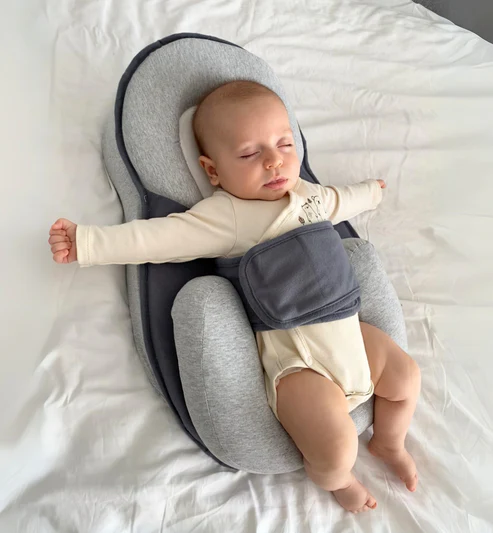
Once I started tracking sleep setup instead of symptoms, the pattern was obvious. Every baby in the "gets better fast" group was spending long stretches upright or slightly elevated — a car seat, a swing, a chest. Every baby still struggling at month five was flat. Flat cot, flat moses basket, with the only elevation being the thirty minutes of upright holding after each feed, before going straight back to horizontal for the other twenty-three and a half hours.
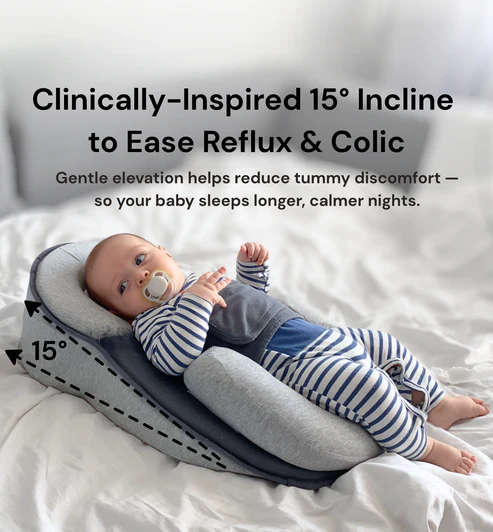
There's a well-documented reason for this. When a baby lies flat, the valve between the stomach and the oesophagus sits level with the stomach's contents — gravity isn't assisting at all. For a baby with any degree of reflux, flat is close to the worst position available. The same logic applies to trapped gas: a gentle pelvic tilt gives it somewhere to go, while flat on the back offers no help at all.
Which means the fix was never patience. It's position — held automatically, not by an arm underneath.
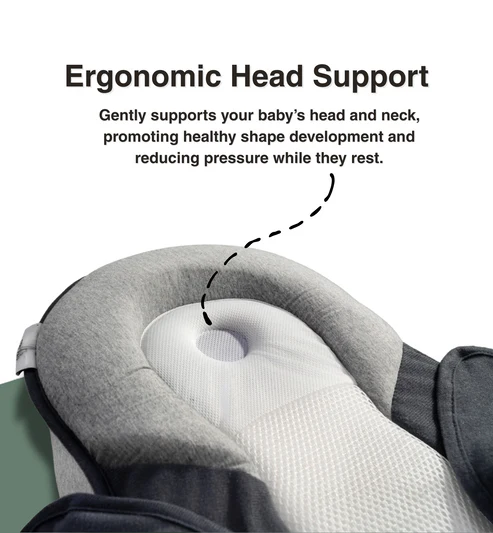
That's the entire idea behind the Soothing Anti-Reflux Baby Nest. A fixed 15° incline keeps stomach contents from rising, cushioned sides create a gentle lift, and the cocoon shape keeps baby feeling held rather than placed on an open, flat surface.
See how the nest works →Why the pillow stack doesn't hold
A newborn doesn't need more cushioning. She needs the angle to actually stay put.
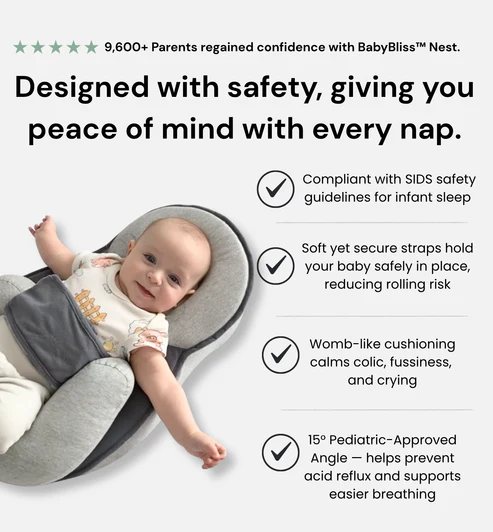
I've seen a lot of well-meaning improvisation — a rolled towel under the mattress, a stack of pillows, a folded blanket wedged against the cot side. Most of it either flattens within an hour, or shifts exactly when nobody's watching, which is worse than doing nothing.
A newborn needs the incline to actually stay an incline through a whole feed cycle, not for the first twenty minutes. The nest's side bolsters and headrest are shaped to hold their position rather than sink flat, and the built-in strap keeps everything where you put it. Held, not propped. That's the difference that mattered every time I compared the two.
See the nest design →Every room, one hand
Her angle doesn't change. Only the room does.
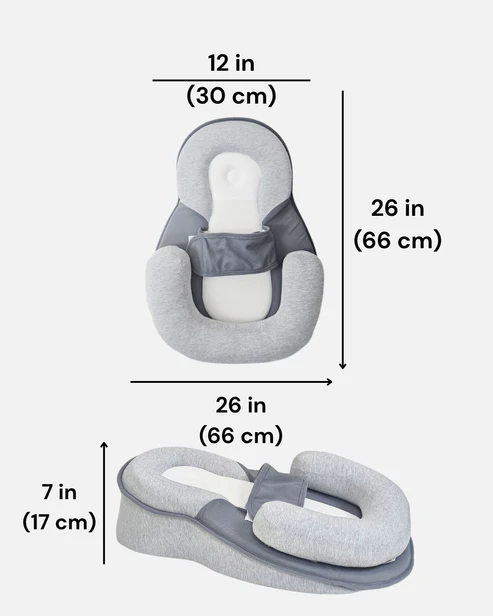
I always tell families the fix has to survive real life, not just the nursery. The nest sits inside most bassinets and prams, so the same incline follows a baby from the bedroom, to the lounge for tummy time, to the car for a visit to grandma's.
It's light enough to carry with one hand, and the cover unzips and goes straight in the wash — which will matter to a tired parent far more than any spec sheet lets on.
Check the size and weight →The rule we print on the box
Positioning helps with reflux and gas. It doesn't replace safe sleep guidance.
I'll say this plainly, because a lot of brands selling products like this one won't.
There are pages live right now claiming an inclined nest or pod prevents SIDS, cures colic outright, or means you never need to think about safe sleep again. We're not making those claims, and neither should anyone selling you one of these.
The Soothing Anti-Reflux Baby Nest is not a medical device. The 15° incline and cushioned support are built on the same gravity-assisted positioning many parents already use holding their baby upright — but for unsupervised or overnight sleep, we still recommend following standard safe sleep guidance: flat, firm, on the back, in a cot or bassinet that meets the relevant safety standard, with the baby always supervised, especially in the early months.
If a brand tells you their product replaces safe sleep guidance, walk away from that brand.
Including us.
The honest use list
What families actually use it for, week to week.
- Supervised elevation for twenty to thirty minutes after a feed, to help stomach contents settle
- Supervised daytime naps and rest, within eyesight, instead of on someone's chest
- Tummy time — flip the setup and use the incline the other way around
- A soft, contained landing spot for awake play between feeds
- Travel: fits inside most bassinets and prams for the same angle away from home
- Giving a partner or grandparent a way to settle baby that doesn't rely on one person's specific hold
Six things. All with an adult in the room for any sleep. That list is shorter than what some competitors promise, and every line on it is honest.
Get one →Half price while stock lasts
$189.99$94.95
or 4 interest-free payments with Afterpay
Get the Baby Nest — 50% off Read customer reviewsThe handover
It gives the whole family a way in, not just the person with the "trick."
The families I see struggling longest are usually the ones where one parent has become the only person who can settle the baby — because settling means one very specific hold, practised hundreds of times, that nobody else has learned.
A defined, engineered position doesn't require that kind of technique. A partner can use it. A grandparent can. Whoever's in the room can. The job stops sitting with one exhausted person by default — which, across the families I've worked with, tends to matter as much as the reflux itself.
What it costs
Less than most of what ends up unused in the nursery.
I've walked into a lot of nurseries with a wipe warmer nobody plugs in, a $200 bouncer used exactly once, and a steriliser replaced by a saucepan of boiling water by week two.
The nest is $94.95 right now, down from $189.99. Free delivery anywhere in Australia, Afterpay if you'd rather split it, and 30 days to decide whether it earns its place. If it doesn't, send it back for a refund.
Claim 50% off →Before you order
The questions we get most.
Can my baby sleep in it unsupervised, overnight?
We recommend supervised use, especially in the early months. For any unsupervised sleep, including overnight and daytime naps, follow standard safe sleep guidance: a flat, firm surface, baby on the back, in a cot or bassinet that meets the relevant safety standard, face uncovered.
What age is it suitable for?
The nest is designed for newborns up to approximately 6 months — the window when reflux, colic, and gas symptoms are most common. Stop use once your baby can roll or push up unassisted.
What's it made from?
A hypoallergenic cotton-blend outer with breathable mesh sides. It's BPA-free and non-toxic. The cover is removable for washing.
How do I wash it?
Unzip the removable cover and machine wash on a normal cycle. Let it dry fully before putting it back on the nest.
How big is it?
Approximately 60 x 35 x 15 cm. It's designed to fit inside most bassinets and prams — always check it lies flat without folding or bunching before use.
When will it arrive?
Orders ship within 24–48 hours with an Australia Post tracking number, free anywhere in Australia.
What if we don't use it?
Send it back within 30 days for a full refund. Email support@cutehomeaustralia.com and we'll sort it out.
The position matters more than anything else you'll try.
$189.99$94.95
Free delivery Australia-wide · 30-day money back · Afterpay available
Get the Baby Nest — 50% offSafe use. The Soothing Anti-Reflux Baby Nest is a positioning aid intended for supervised use, especially in the early months. It is not a substitute for safe sleep guidance. For any unsupervised sleep, always place your baby on a firm, flat surface, on their back, in a cot or bassinet meeting the relevant safety standard. Never use on an elevated surface such as a bed, lounge, bench or table. Stop use once your baby can roll or push up unassisted.
Not medical advice. Nothing on this page is a medical claim. The nest is not a medical device and is not designed, tested, or sold to diagnose, treat, prevent, or cure reflux, colic, flat head, or any other medical condition. If your baby is unsettled, feeding poorly, or bringing up feeds, speak to your GP, child health nurse, midwife, or paediatrician.
Advertising disclosure. This page is an advertisement published by Cutehome. The account above is presented as told by a community midwife to this publication and has not been independently verified. Individual experiences vary.