“Why Your Bunion Keeps Getting Worse (And Why Every Spacer Failed)”

If you have been hiding your feet, skipping pedicures and dreading sandal season, read this before you decide surgery is where this ends. This is not another gel pad or bulky brace.
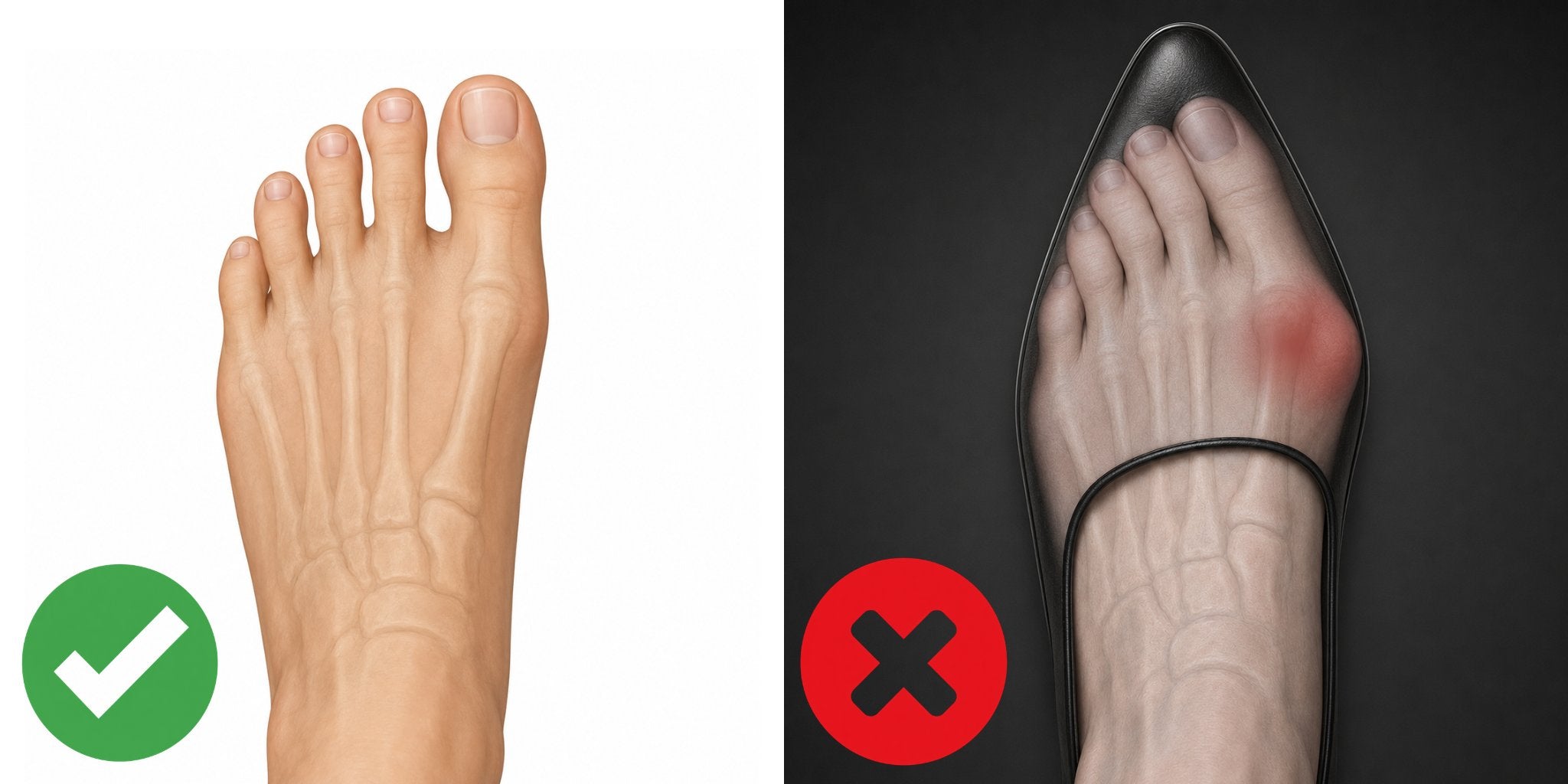
For years, the standard advice has quietly failed a lot of people.
And the reason it kept failing was never your feet.
And no, it isn't another gel pad or bulky brace.
Why the usual advice keeps failing
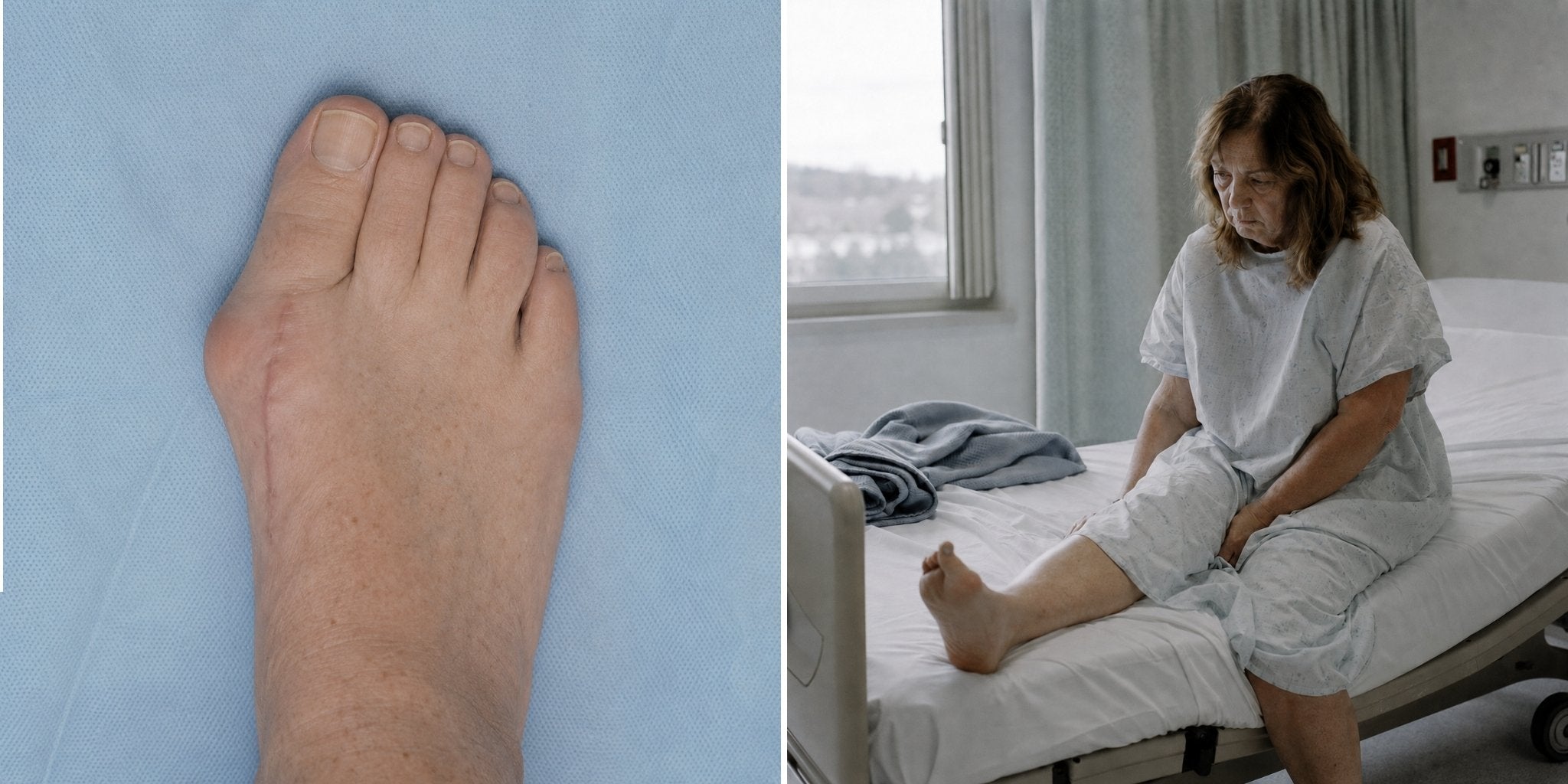
For many people the story goes the same way. Wider shoes. A spacer from the chemist. Wait, and see how it goes.
They follow the advice to the letter, and the bump keeps pushing back through.
None of that advice was ever built to fix a bunion.
It was built to wait. Come back when it is worse. Come back when you cannot bear it. Then talk about surgery.
The things people quietly stop doing
It doesn't start with pain.
It starts with the small things you stop doing.
You stop buying sandals. Not all at once. You just notice one summer that you haven't owned an open pair in years.
You cancel a pedicure and don't book another for two years. You can't stand the thought of a stranger holding your foot up to the light.

You stop swimming. Not because you can't. Because you can't take your shoes off in front of anyone. You sit by the pool with a towel over your feet and say you're fine where you are.
And you stop looking. You step out of the shower and dry your feet without once glancing down, because you already know what's there and don't want to see it again.
None of that is the part anyone warns you about. It is quieter than pain, and somehow worse.
And it doesn't always stay in the foot. When one toe stops taking its share, other parts of the body can end up compensating. Many people find they start walking differently without ever deciding to.
Underneath all of it sits a fear that rarely gets said out loud: that it started as a bump you could hide, and could become a shape you can't look at.
The real reason it keeps getting worse
Most of us grow up hearing that bunions are genetic. Plenty of families have them, so it's an easy conclusion.
But there's a chart worth looking at.
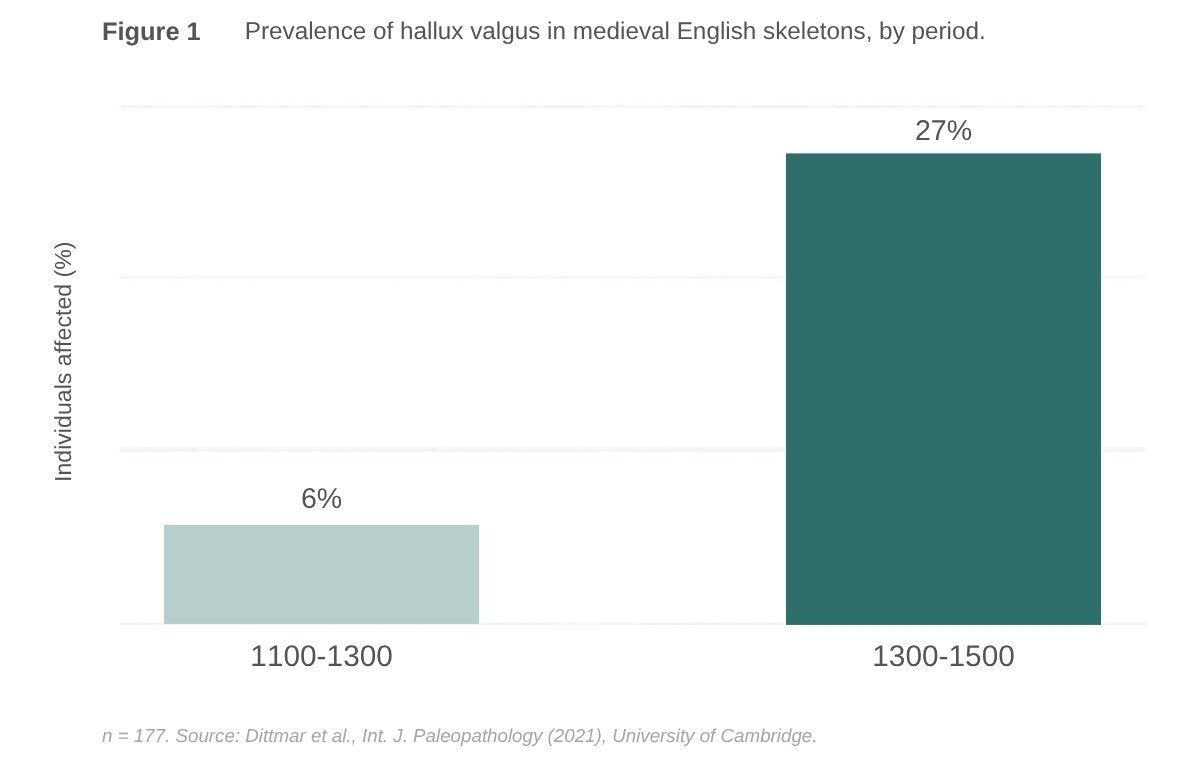
A Cambridge team examined hundreds of medieval skeletons. Before the 1300s, barely six in a hundred had bunions. Then pointed shoes became the fashion, and within a century more than a quarter did.
Same country. Same bloodlines. One thing changed. The shoes.
Bunions are also reported to be far less common in people who grow up barefoot. What we inherit is the shape of the foot. The bunion itself is built, slowly, by the shoes we force it into.
The joint was never broken. It was pushed.
And if shoes can build it slowly, it was never a finished story. There is room to do something about the pressure that keeps pushing it.
Why every spacer you've tried failed
But hope and a solution are two different things.
Most people have already been through the cycle. Every few months, something new promises it will finally work. You read the reviews. You order the one everyone swears by. You wait two weeks for it to arrive. And you put it on that first morning with the same small hope.
Maybe this is the one.
Then the soft ones squash flat and slide out before you reach the car. The firm ones dig in, so you can only bear them an hour on the couch, which is not where you live your life. And not one was ever the right size, so not one ever stayed where you put it.
Different every time. Useless every time. And every time, the hope comes out a little thinner.
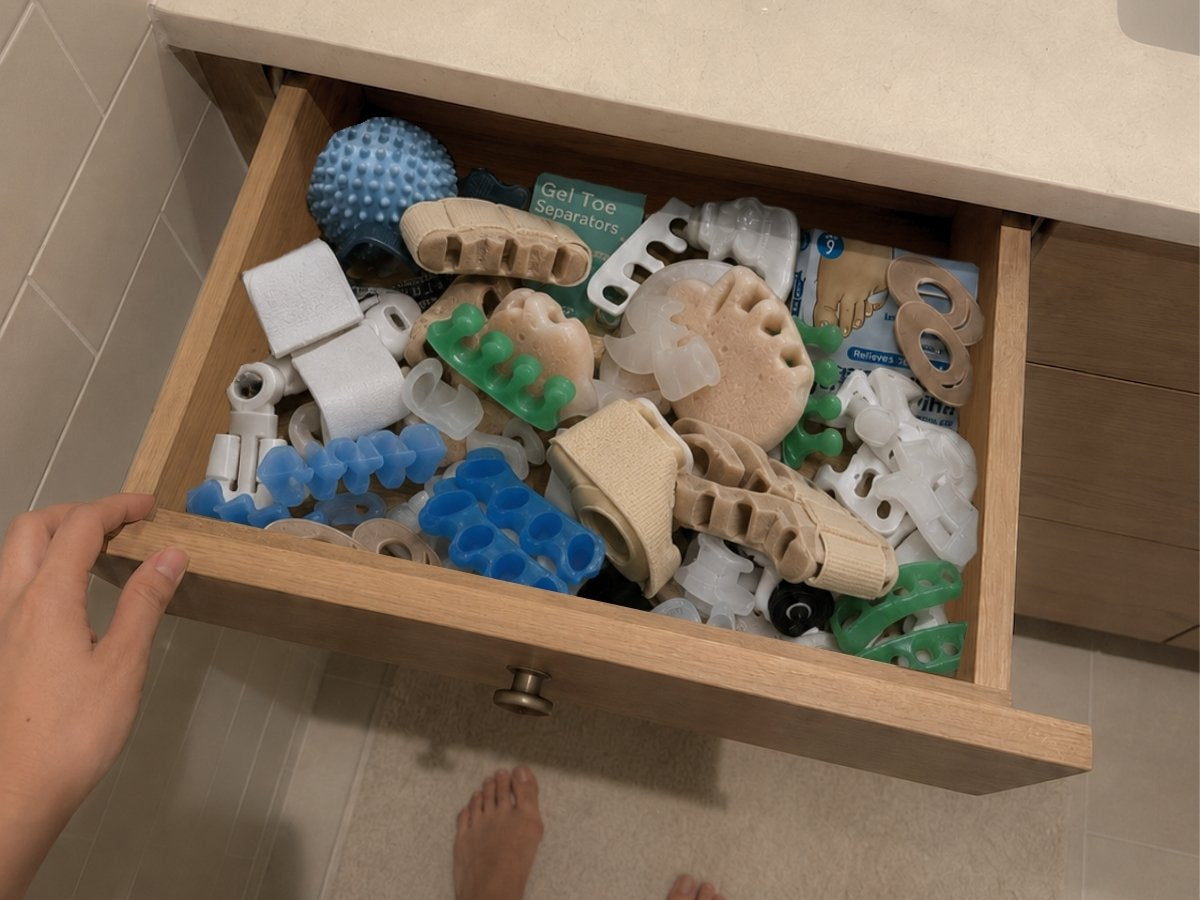
Eventually, you stop. You decide that nothing works on feet like yours, and you put the last one in the drawer with all the others.
Meanwhile your shoes keep pushing that toe inward every hour you are on your feet. All day. Every day. And what's been pushing back? A soft gel one that's out of place before you get to the car. A hard plastic corrector you can manage an hour of, on the couch. A night splint so bulky you wake at 2am and pull it off.
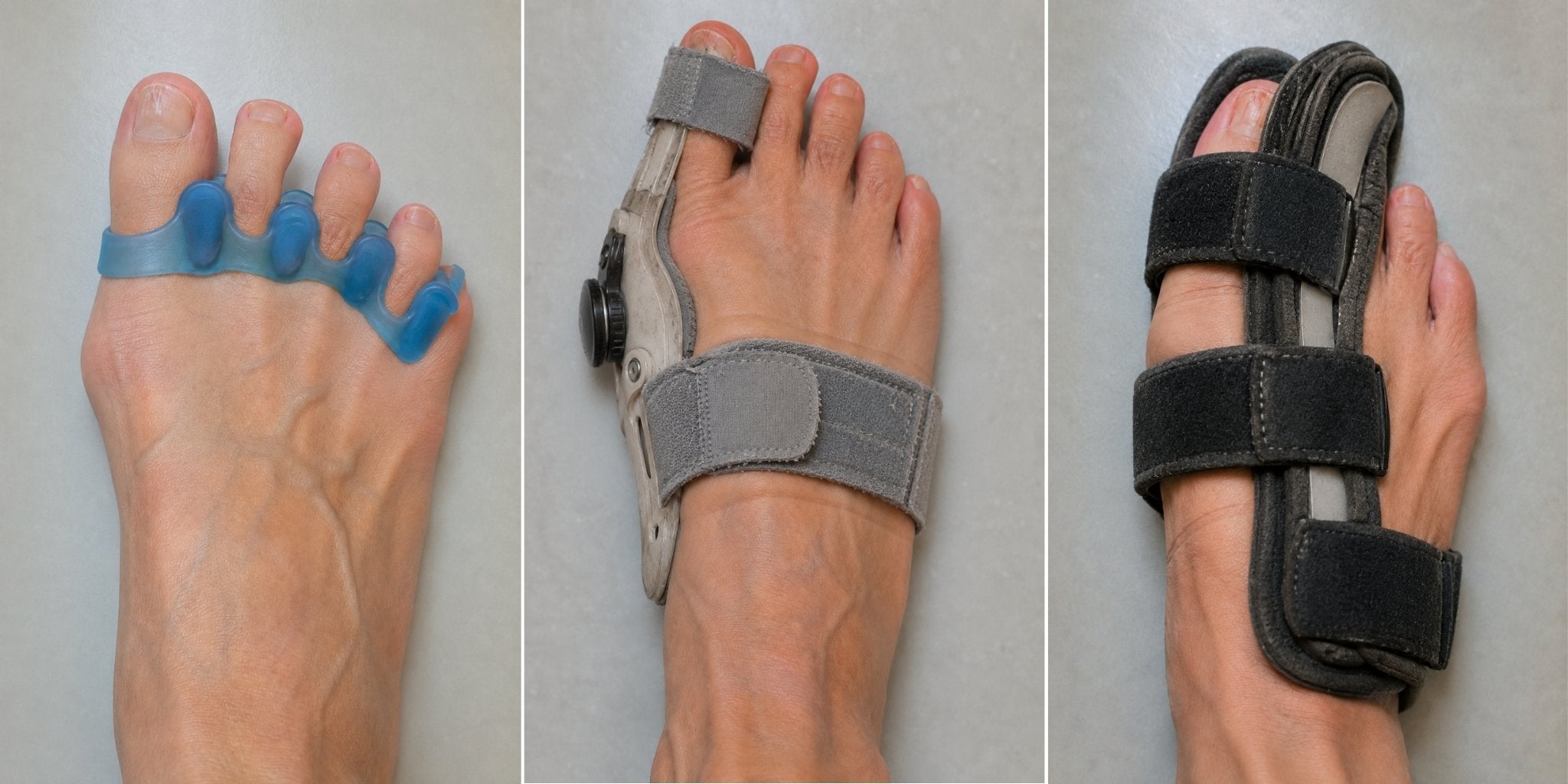
Minutes, against years. Not one of them ever stayed in long enough to do a single thing.
That was the whole reason. Not your feet. Nothing ever fit well enough to stay where you put it.
What's different about a sized spacer
Look at the spacers you've bought before. Almost every one is one-size.
But no two people have the same foot. One-size can't fit anyone properly. It can only be near enough for everybody, and near enough is exactly what most people have been getting.
One is so loose it works itself out by lunchtime. Another is so tight it leaves your toe white and you pull it off in the car.
A spacer that moves is a spacer that comes out.
The CUTEHOME Sized Toe Spacer comes in small, medium and large, so you can pick the fit that matches your foot. Firm silicone, not the soft gel that had squashed flat on me a dozen times.
The reason it works
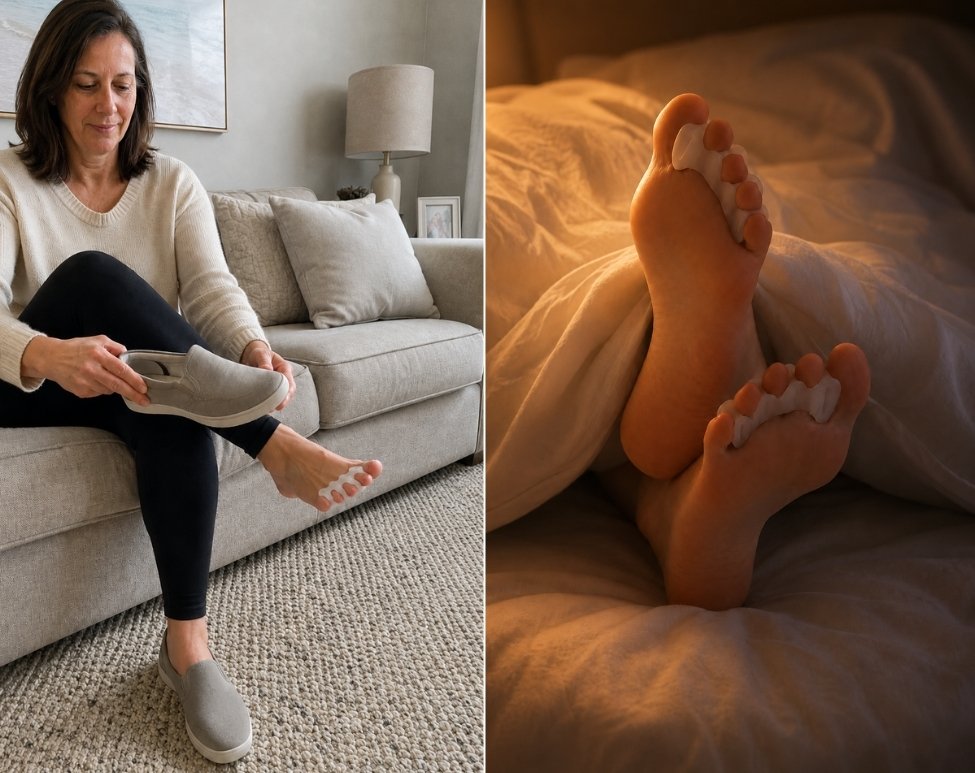
It's designed to work the way braces do. Not one hard push. A gentle hold, kept in place, every day.
That steadiness is the whole point.
It's the one thing a soft gel that folds flat by the car park, or a bulky brace you rip off at 2am, could never give you.
And it asks very little of you. Pick your size. One in each shoe in the morning. Get on with your day. In my shoes all day, and in bed all night.
No routine. No twenty minutes on the couch you'll skip by Wednesday. You wear it the way you already wear your shoes.
What to expect, week by week
We want to be honest about the pace. Anyone promising an overnight fix isn't being straight with you, and a spacer won't change your bone structure by itself. Comfort, fit and steady daily wear are what to look for.
I want to be honest about the pace.
Anyone promising you an overnight fix is lying.
This took time. That it took time is how I knew it was real.
Day one, the rubbing stopped.
I got to the end of a full shift and the raw spot on the side of my foot had not flared once.
That was new.
The first few days, my foot felt full. Almost worked.
The way your back feels the afternoon you finally sit up straight after years of slouching.
Then it settled, and I stopped noticing it was there.
By the end of week one, the ache had eased.
That deep sideways throb you cannot press out.
I reached for the ibuprofen less, then some days not at all.
By week three, I stopped thinking about my feet.
Every step had been a small reminder for years.
Then one day it just was not.
By week eight, I could see it.
The redness along the side had gone down.
The swelling that used to sit over the joint was smaller.
The toe looked like it was sitting straighter than it had in years.
Not perfect. But real.

The kind of change that makes you stop and think, why did I not start this sooner.
I finally booked the pedicure I had cancelled two years before.
And the socks I wore to bed so my husband would not see my feet.
I stopped reaching for them.
It was not my feet that came back first. It was everything I had stopped doing because of them.
What we'd suggest
If you've been carrying the same bump for years and have been told to wait and see, it's worth trying a simple, low-cost option before anything more invasive, and talking to a podiatrist or your GP about whether surgery is right for you.
I am a nurse.
I do not tell a woman to spend her money on something unless I have watched it work with my own eyes.
For twenty years, that meant I had almost nothing to give them.
Wider shoes. A gel spacer from the chemist. Wait, and we will operate.
I said it because it was the list, not because it worked.
Then it worked on my feet.
So I did the thing my training never let me do lightly.
I put my name on it.
I started telling the women who sit in my chair, the ones carrying the same bump I hid for ten years, to try this before they let anyone near their foot with a knife.
I have watched it work on dozens of feet since.
Women who walked in with a surgery date already set.
Women who had given up on ever fixing it.
I need you to hear why I am telling you this.
I have sat with too many women in a recovery bay, crying over a foot that surgery left worse than it found.
That is what I am trying to keep you from.
Not with a promise.
With the one thing I have watched actually hold, on my feet and on theirs.
Here are a few of the patients I referred to the Alyyne Splay.
I think the transformations speak for themselves.

What it costs, and what it saves you
No countdown clock and no fake discount.
Here are the two roads many people take, and what each can cost.
You keep going back because none of it addresses the cause. Your shoes push that toe inward every hour you are on your feet. That is what has to be answered, and it has to be answered on the same hours.
Against all of that, this is a spacer for $44.99, and you can start the day it arrives.
Most people end up with two sets, and here is the honest reason. This works on the hours you give it and the days you never skip. So one pair lives by the bed, for the hours you are asleep. The other lives by your shoes, for the hours you are up and about. One is always clean and dry while the other is in the wash.
You choose your size (S, M or L) when you order. You measure your foot once, using the guide on the next page, and order the size it gives you.
If it is not right for you, our 30 Day Money Back Guarantee gets your money back. Just email support@cutehomeaustralia.com.
Check AvailabilityThe next ten years are yours to pick
Ten years ago a bunion may have been a bump you could hide. It's easy not to think about the next ten.
Picture it.
You close this page and nothing changes. The same shoes fighting your foot every day. The socks. The sandals you do not buy. And somewhere down the line, the surgery conversation you keep pushing off, finally here.
Or you try something that costs less than a dinner out, with thirty days to change your mind, and you find out now instead of wondering for another ten years.
It was never your feet. It was the fit.
Find your size below.
Check Availability— Claire Henderson, RN
Check AvailabilityComments
THIS IS AN ADVERTISEMENT AND NOT AN ACTUAL NEWS ARTICLE.
The information presented here is not intended as specific medical advice and is not a substitute for professional diagnosis or treatment. CUTEHOME products are not intended to diagnose, treat, cure or prevent any disease.
Results shown in testimonials are illustrative and may not be typical. Individual results vary and depend on severity, consistency of use and wear time. Consult a qualified health professional about any foot concern.
This site receives compensation for purchases of products featured.
© 2026 CUTEHOME. All Rights Reserved.